


Blockchain was originally created to facilitate bitcoin transactions by enabling secure and traceable peer-to-peer deals without a central authority. Subsequently, blockchain has become a buzzword because of its broad potential. Today, blockchain is being explored across a range of areas, including supply chain and inventory tracking, digital identity, smart contracts, and digital asset accounting. Blockchain is a shared, immutable ledger that enhances audit trails by securely recording transactions across a business network. It is a distributed and decentralized ledger system that records transactions in a secure, transparent, and tamper-resistant platform.
The blockchain is handled by computers (known as nodes) that are allowed into the participating network. Typically known as a “block,” each transaction is encrypted, timestamped, and validated by each node of the blockchain database using a set of rules codified as consensus algorithms. Each new transaction block is attached in sequence to a previous transaction block, thus yielding a “chain” of transaction blocks—a blockchain. This architecture ensures that once a transaction is validated and input into the system, it can never be deleted, edited, or altered, ensuring the immutability of the blockchain. Ultimately, blockchain enhances data integrity, auditability, and trust, allowing accountants to shift focus from recordkeeping to analysis and assurance.
Furthermore, in response to stakeholders from various professional backgrounds requesting more relevant information on crypto assets, FASB issued Accounting Standards Update (ASU) 2023-08, Intangibles—Goodwill and Other—Crypto Assets, which requires firms to disclose their fungible crypto assets at fair value (https://tinyurl.com/ms8xkp5x). Given that most crypto assets reside on blockchain-based distributed ledgers, ASU 2023-08 underscores its importance. CPAs do not need to become blockchain engineers, but they are advised to understand blockchain in an accounting context, especially if their employers or clients own crypto assets.
Blockchain Technology
CPAs can conceptualize Blockchain as a general ledger shared across multiple parties: each transaction is time-stamped, verified by the network, and stored in a block, which is encrypted using a special hash code. These blocks are linked in sequence to form a permanent chain, which prevents past entries from being altered. Because all authorized participants see the same data in real time, blockchain reduces the need for reconciliations and manual verification. It also supports automation through “smart contracts,” which can trigger transaction recording when conditions are met.
The term “smart contract” was coined by computer scientist Nick Szabo in the 1990s to describe automated and self-executing tasks (“History of Smart Contracts From Nick Szabo to Ethereum,” Nadcab Labs, https://www.nadcab.com/blog/history-of-smart-contracts). Exhibit 1 presents the comparison between smart contracts in blockchain technology and accrual accounting that CPAJ readers know well. Smart contracts can automate and record certain accounting-related transactions, but blockchain cannot replace the full scope of accounting functions governed by GAAP.
EXHIBIT 1
Smart Contracts Versus Accrual Accounting Under GAAP

The primary goal of corporate governance is to establish a framework of accountability, transparency, fairness, and integrity within an organization. Similarly, the goal of blockchain governance is to ensure the network is secure, fair, and runs smoothly. Specifically, blockchain governance refers to the processes and structures used to make decisions about how a blockchain evolves over time, including how protocol changes are proposed, approved, and implemented. Blockchain protocols are the rules and standards that govern how data is created, validated, and shared across a blockchain network.

Blockchains are classified into four types: public, private, consortium, and hybrid, as described in Exhibit 2. Public blockchains allow permissionless (or unrestricted) access to any participating member, making it less appropriate for sensitive financial data. Both private and consortium blockchains provide permissioned (or restricted) access to members to read, write, or validate transactions on the blockchain. Hybrid blockchains afford partially permissioned access in which permissionless access is available to any member to view audit trails of the ledger, while permissioned access is provided to authorized members to implement financial logic or validate transactions. Blockchains used in business enterprises are usually private or permissioned, granting rights to only certain parties to read and write transactions.
EXHIBIT 2
Types of Blockchain

Blockchain-as-a-Service (BaaS) has emerged as a viable solution for enterprises, owing to its advantages in expediting application development and reducing initial infrastructure expenditures. For example, IBM’s BaaS is used by major companies such as Walmart, CVS Health, Cigna Group, and Ford. Amazon Managed Blockchain serves organizations including Nestlé, Accenture, and Guardian Life Insurance. In addition, several companies, including American Electric Power, Abbott Laboratories, HealthSync, and Alpha Acid Brewing, have adopted Oracle Blockchain Cloud Service for various enterprise applications [“What is Blockchain as a Service (BaaS) in the Tech Industry,” July 23, 2025, https://tinyurl.com/4rds684r].
Comparing Functionalities
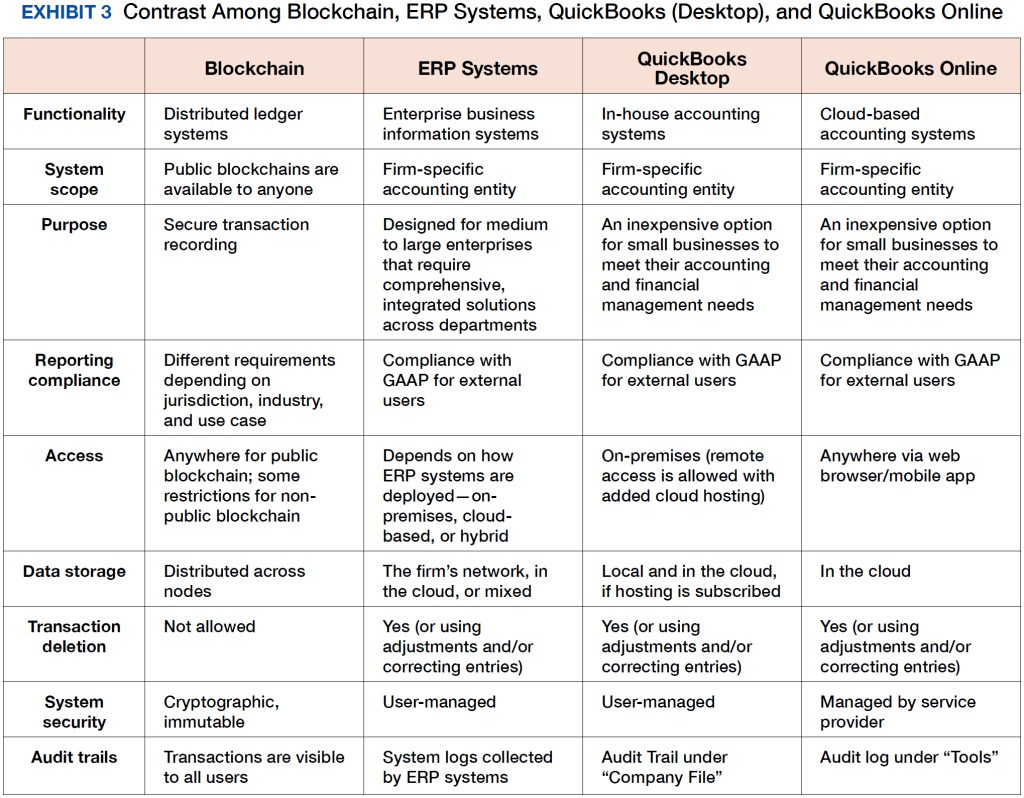
Although financial accounting also uses ledgers to organize an entity’s transactions, there are additional tasks, such as using entries to record an entity’s operational data, posting entries to ledgers, calculating account balances, and performing financial reporting that can be utilized to help internal and external users understand its financial performance and health. Thus, financial accounting transforms a business’s daily transactions into reliable accounting reports and financial statements. Even though blockchain can complement traditional accounting data collection by improving efficiency, accuracy, and transparency, it focuses on recording immutable transactions and does not have the capacity to handle all other functions of a typical accounting system.
Exhibit 3 compares and contrasts blockchain, ERP systems, QuickBooks (desktop), and QuickBooks Online. This illustrates that blockchain is not going to replace an entity’s accounting systems. Instead, blockchain may enhance or transform certain parts of accounting systems, especially the procurement cycle. Thus, CPAs should view blockchain as a complementary technology that can improve accuracy, transparency, and reliability of some financial data.
EXHIBIT 3
Contrast Among Blockchain, ERP Systems, QuickBooks (Desktop), and QuickBooks Online
Importing Blockchain Data into Accounting Systems
To facilitate the financial reporting of all the transactions of an accounting entity, companies that engage in blockchain-based transactions must integrate those transactions into their accounting systems. Many software vendors offer interfaces and tools to import blockchain transactions and integrate the decentralized data with the business data collected by their ERP systems. The inexpensive QuickBooks Desktop and QuickBooks Online (QBO), however, do not have the built-in features to facilitate blockchain data processing or integration. Nonetheless, QBO offers a Representational State Transfer (REST) Application Programming Interface (API) for developers. Exhibit 4 lists the interface/tools and integration methods offered by several accounting system vendors to incorporate blockchain transactions into accounting systems.
EXHIBIT 4
Interface/Tools, Integration Methods, and Use Cases for Importing Blockchain Data

Cybersecurity Risks Faced by Blockchain Platform Users
While blockchains support secure, tamper-resistant, and transparent data processes, they are not immune to cybersecurity attacks and threats. Systematic cyberattacks on blockchain networks have led to major security breaches, resulting in substantial financial losses. For example, Dubai-based Bybit Crypto Exchange suffered a $1.46 billion loss after malware deceived the platform into authorizing unauthorized transactions (“Crypto’s Biggest Hacks and Heists After $1.5 Billion Theft from Bybit,” Reuters, Feb. 24, 2025, https://tinyurl.com/yrf9behh).
Blockchain platforms are vulnerable across multiple layers, including the protocol, consensus mechanisms, smart contracts, wallets, exchanges, and user behavior. Cyberattacks can target any of these components. For example, phishing attacks deceive users into revealing private keys—analogous to passwords for cryptocurrency wallets—enabling fraudulent transactions. Smart contracts are particularly susceptible if they contain bugs, as they are immutable once deployed. A malicious contract can repeatedly exploit a vulnerable one, potentially causing severe financial losses. The protocol layer is also at risk. In Proof-of-Work (PoW) systems, attackers may attempt a 51% attack, where control of the majority of the network’s computing power allows them to manipulate the blockchain, potentially introducing counterfeit transactions or alternate chains. Another critical threat is collusion, where two or more nodes secretly cooperate to manipulate outcomes for personal gain. This undermines the integrity, trust, and security of the blockchain network.
Under SOX section 404, the management of public companies must assess and report on the effectiveness of internal controls over financial reporting. Consequently, public companies should implement robust controls to safeguard their accounting systems, including measures to mitigate cybersecurity attacks and threats. Furthermore, the US Securities and Exchange Commission (SEC) has implemented mandatory cybersecurity disclosure requirements that directly impact financial reporting for public companies. These requirements strive to enhance transparency and consistency in how companies report cybersecurity risks and incidents (“SEC Adopts Rules on Cybersecurity Risk Management, Strategy, Governance, and Incident Disclosure by Public Companies,” SEC Press Release, July 26, 2023, https://tinyurl.com/34dcmhwa).
If a blockchain platform is no longer under the direct control of a user company, independent verification of controls and security measures by a CPA firm may be necessary. Systems and Organization Control (SOC) Engagements are assurance services that CPAs can provide to evaluate system-level controls of service organizations, including blockchain platforms. If needed, blockchain platform users should request a copy of SOC 2 audit report from the service providers. The SOC 2 report provides detailed information and assurance about a service organization’s security, availability, processing integrity, confidentiality, and privacy controls, based upon their compliance with the AICPA’s Trust Services Criteria.
Finding Blockchain Expertise
To the best of the authors’ knowledge, hands-on learning of blockchain is not yet included in the curricula of most accounting programs. Thus, CPA firms must look to non-accounting graduates. For example, as far back as 2017, one accounting firm reported that more than 25% of its new entry-level hires are science, technology, engineering, and math (STEM) majors (Allan Koltin, “Koltin’s Top 10 Soundbites of the Year,” December 2017, https://tinyurl.com/4cj8rybx). According to the 2021 AICPA Trends Report, 42.7% of new graduates hired by public accounting firms were non-accounting graduates. This trend is partly driven by the fast-evolving, IT-intensive workplace that demands updated skills from accounting professionals.
Furthermore, CPA firms can take advantage of seminars, workshops, and continuing professional education (CPE) to offer training on blockchain for employees. For example, the AICPA offers a variety of training on blockchain, including self-study courses, webcasts, and a certificate program geared toward CPAs and finance professionals (https://tinyurl.com/9ahfbsev). Generally, it takes longer for existing staff to develop new IT skills, and they need adequate support to complete the transformation and adapt to a new technology.
Finally, large accounting firms tend to recognize the benefits of using a new technology during its early stages. At a panel discussion on blockchain technology in 2017, Amy Pawlicki from the AICPA Assurance Services Executive Committee pointed out that companies were implementing blockchain into their ERP systems, particularly for tasks such as procurement and supplier management; thus, some CPA firms realized the implications of blockchain for their clients early on (Ken Tysiac, “Blockchain: An Opportunity for Accountants? Or a Threat?” Journal of Accountancy, Nov. 17, 2017, https://tinyurl.com/yewuaay4). Today, most of the international CPA firms offer services for companies that lack in-house blockchain expertise.


